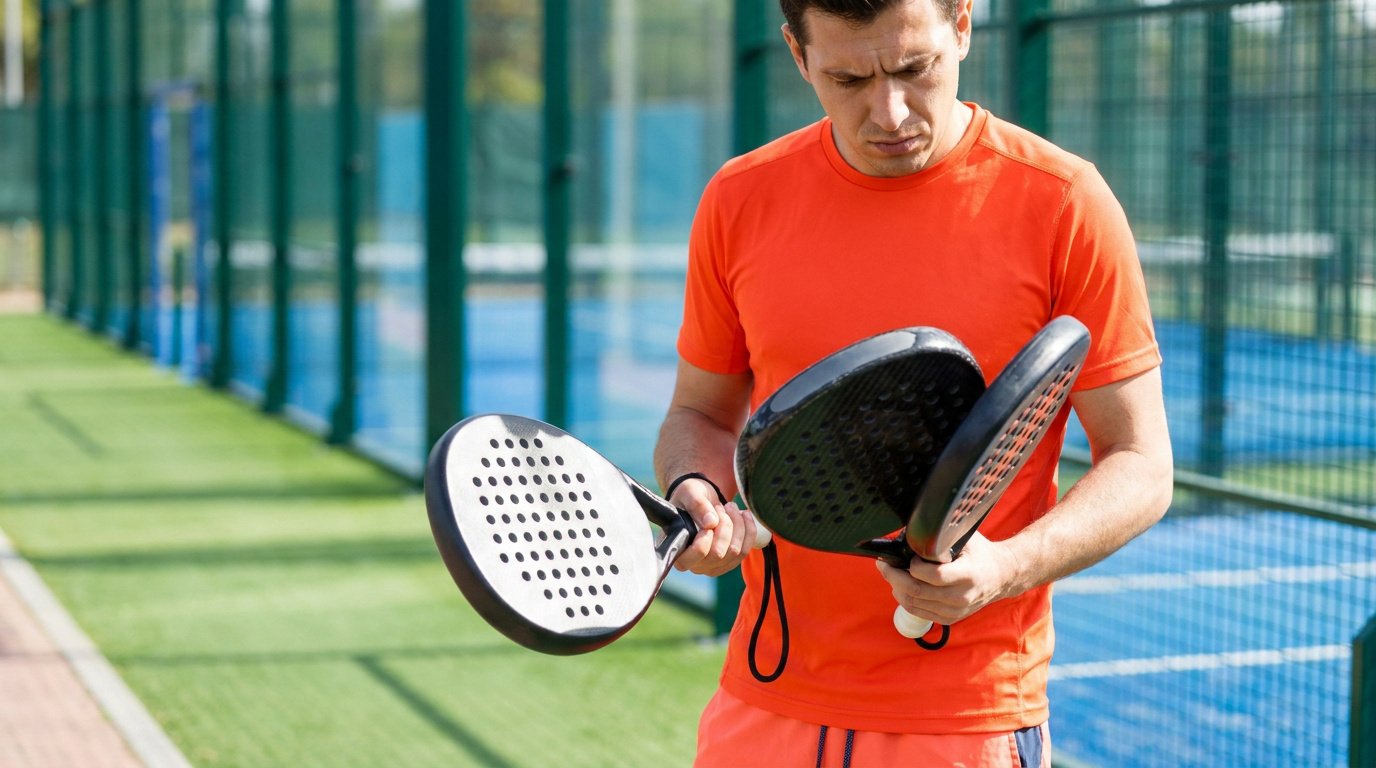
A top-end racket can wreck your progress if its stiffness punishes every technical flaw. To start with pleasure, prioritize the forgiveness of a round head and the softness of fiberglass. This guide explains how to choose your padel racket by betting on lightness and a low balance to protect your joints.
- Choose your padel racket: shape dictates your style
- Find the right weight and balance without getting injured
- Materials and foams for precise shots
- Move up to intermediate-level play
- Maintenance and accessories to last on court
Choose your padel racket: shape dictates your style
Once you’ve stepped on court, you quickly realize that the tool makes the player. But before talking technique, everything starts with the geometry of your pala.
- Choose your padel racket: shape dictates your style
- Find the right weight and balance without getting injured
- Materials and foams for precise shots
- Move up to intermediate-level play
- Maintenance and accessories to last on court
Maximum forgiveness from the round shape
The round head is the natural ally of beginners. It delivers optimal control on every strike. The weight sits ideally near the handle.
Our Head Speed Motion review is a good illustration of this profile: round shape, low balance, tolerance before power.
This geometry happily forgives recurring centering errors. The sweet spot is wide and central on the face. It lets you send the ball back cleanly. It’s perfect to choose your padel racket and learn calmly.
Maneuverability comes first. You feel more confident during fast rallies.
Teardrop and diamond for extra bite
The teardrop is the perfect compromise. It blends power and control beautifully. It’s the most versatile shape on the market.
The diamond is for purely offensive players. The head-heavy weight radically boosts energy transfer. Smashes become much more punishing. Solid technique is required.
Our Bullpadel Hack 03 review details exactly this trade-off on a diamond built for attackers.
Your choice depends on your aggression level. Match your needs in attack.
Identifying the ideal sweet spot
The “sweet spot” is the zone where the strike is pure. Its exact position changes with the geometry you pick. It guarantees optimal performance.
An off-center hit often triggers an unpleasant vibration. A diamond racket has its sweet spot up high. The round shape puts it in the middle. This impacts your playing comfort.
Try several models to feel it. Your arm will thank you.
Find the right weight and balance without getting injured
Once the shape is picked, you’ve got to lift the beast. The weight on the scale doesn’t tell the full story of the feel in hand.
The art of choosing the right gram weight
Aim for a standard range around 360 grams. It’s a balanced weight for most players. Neither too heavy, nor too light.
Lightness boosts your reactivity. A light padel racket lets you move faster. You intercept reflex volleys better. It’s a major advantage on defense.
Watch out though for the lack of stability. A pala that’s too light can vibrate excessively.
Mass distribution and maneuverability
A handle-weighted balance changes everything. It favors comfort and maneuverability. Your arm fatigues much more slowly.
A head-heavy balance creates a powerful leverage effect. It boosts centrifugal force on the smash. Raw power is then multiplied. But watch out for wrist fatigue.
Find the middle ground to last. A neutral balance remains a safe bet.
Differences between men’s and women’s models
Let’s break down the specific weight variations. Women’s models are often lighter. They range between 345 and 360 grams.
Bust the myths around power. A light racket can be very lively. It all depends on the rubber used. Design isn’t the only criterion.
What matters is the personal feel. Don’t trust marketing alone.
Materials and foams for precise shots
Beyond weight, what’s hiding under the surface changes everything. The core of the racket defines your ball feel.
Fiberglass vs carbon
Fiberglass brings a welcome softness. It’s ideal for starting padel calmly. This material delivers an easy ball release without effort.
Conversely, carbon stiffness is for experts. This material is far more responsive on court. It enables surgical precision in attack. It’s a durable, high-performance choice for competition.
Fiberglass absorbs shock better. Carbon demands more arm. Choose based on your strength. Browse models on the Babolat padel rackets page.
EVA foam vs FOAM: the heart of the matter
FOAM perfectly absorbs vibrations. It’s very soft and comfortable at impact. It’s ideal to avoid elbow pain.
EVA foam bets everything on power. It has excellent shape memory after impact. The ball flies off the face very fast. It’s the standard for intense competition.
Here are the key points:
- FOAM benefits: comfort, absorption, easy ball release
- EVA benefits: durability, power, precise control
Temperature impact on density
Heat softens the rubber of your pala. In summer, the racket becomes more flexible. You lose a bit of directional control.
Adapt your game in winter. Cold hardens the internal materials. The pala then feels stiffer and drier. You have to hit the ball harder to push it forward.
Store your gear indoors. Avoid harsh thermal shocks.
Move up to intermediate-level play
Starting to master the bandeja? It might be time to change your weapon to reach the next level.
Nailing the transition without losing your bearings
Your technique sharpens and your needs evolve. You might be looking for more weight or reactivity. Identify whether your current racket is limiting your progress in power or precision.
The Nox AT10 Genius Attack is a typical step-up racket for this stage: hybrid shape, versatile balance, price well below the pro models.
To avoid making the wrong call, test the racket over two full matches. Evaluate its behavior in defense and on smashes. Never judge a model on just ten minutes of play.
Keep characteristics close to your old pala. To choose your padel racket well, avoid jumping suddenly from a light round model to a heavy diamond.
Used or new for a first purchase
Buying second-hand carries real risks. Internal micro-cracks sometimes remain invisible to the naked eye. The structure may already be weakened by prior impacts or poor storage.
A new product guarantees an intact, high-performance foam. The manufacturer’s warranty brings indispensable security against manufacturing defects. It’s often a far more profitable investment over time.
Used gear is still an option to test a style. To play seriously, prefer new gear.
Wear signs and end of life
The foam eventually loses its natural elasticity. The racket then feels “dead” at impact. It no longer returns the ball with the same liveliness as in the beginning.
A dull sound or abnormal vibrations should alert you immediately. Carefully check the outer frame condition. Deep cracks often mark the end of life of your gear.
A racket lasts about a year. It all depends on your actual playing frequency.
| Wear sign | Probable cause | Recommended action |
|---|---|---|
| Power loss | Packed or softened foam | Replace the racket |
| Cracking sound | Broken internal structure | Stop play immediately |
| Visible cracks | Impacts or frame fatigue | Change racket quickly |
| Arm vibration | Loss of core absorption | Switch to avoid injury |
Maintenance and accessories to last on court
Buying the right racket is one thing, making it last is another. A few simple accessories save your gear and your health.
Prevent pain with the right grip
The overgrip is an indispensable ally for your comfort. It lets you precisely adjust the thickness of your handle. It stops you from squeezing your hand too hard unnecessarily.
It’s an effective weapon against the infamous “tennis elbow”. A handle that’s too thin quickly fatigues your tendons. Add overgrips matching your morphology. The hold must remain totally natural.
Replace them as soon as they slip. Sweat reduces grip and your control.
Storage and frame protection
Use frame protectors without fail. These PVC or rubber adhesive bands absorb impacts. Court walls are often unforgiving on carbon.
Store your gear in good conditions. Keep your bag away from any humidity. Foam doesn’t tolerate thermal swings. An insulated bag is a smart investment.
Avoid direct sunlight. The car in summer is off-limits.
Wrist strap role and hygiene
The wrist strap is mandatory in official matches. It’s a fundamental safety rule. It stops the accidental flying of the racket toward your partner.
Remember to clean or replace it regularly. This cord accumulates enormous amounts of sweat. It quickly becomes an unpleasant bacteria nest. Some Nox or Wilson models are interchangeable.
- Check the attachment before every match
- Never play without wearing it on your wrist
- Dry the wrist strap after exercise
In short
Prioritize a round shape, a light 360g weight and the softness of fiberglass for full control. Grab these advantages now to progress without pain and with pleasure. Choosing your padel racket well transforms every rally into a success to dominate your future matches with confidence.
👉 Going further: discover our guide to the padel smash and our padel lob guide. Or check out the original French version of this racket guide.