Learning the padel rules takes exactly five minutes. That is what makes the sport one of the easiest to pick up as a beginner: no complicated jargon, very few exceptions, and a match format borrowed directly from tennis. You can step on court for your first session and play a proper game within the first thirty minutes.
If you have ever felt intimidated by the glass walls, the underarm serve or the strange tactical patterns of the players, this guide is for you. We have compiled every rule you need before your first session, the most common faults to avoid, and a clear comparison with tennis so you stop second-guessing yourself between points. By the end, you will know exactly how the padel rules work in 2026.
- What are the dimensions of a padel court?
- How many players on a padel court?
- How does the serve work in padel?
- How do you score points in padel?
- When can you play off the walls and the fence?
- What are the most common faults?
- What are the differences with tennis?
- Is there a referee in amateur padel?
- FAQ — Padel rules
- What are the dimensions of a padel court?
- How many players on a padel court?
- How does the serve work in padel?
- How do you score points in padel?
- When can you play off the walls and the fence?
- What are the most common faults?
- What are the differences with tennis?
- Is there a referee in amateur padel?
- FAQ — Padel rules
What are the dimensions of a padel court?
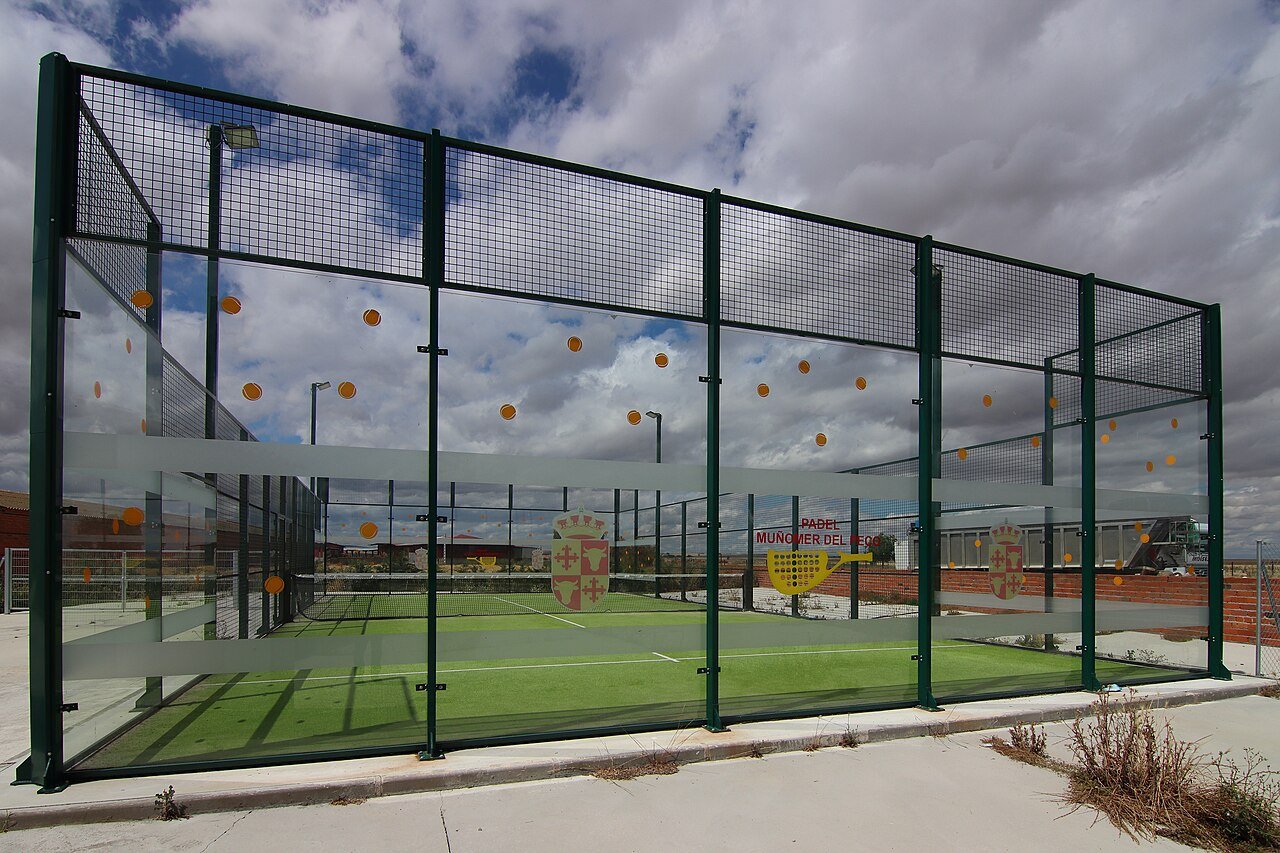
A padel court measures exactly 20 metres long by 10 metres wide. It is split by a net that is 0.88 metres high at the centre and rises to 0.92 metres at the posts. The sides and back of the court are enclosed by two distinct surfaces:
- Tempered glass walls on the back wall and the first 4 metres of the sides (3 metres high).
- Metal mesh fencing covering the remaining side panels (4 metres high).
This enclosed cage is the single most important detail that separates padel from tennis: the ball almost never leaves the playing area. Long rallies, defensive lobs and wall-bounce returns are all consequences of this design.
How many players on a padel court?
Padel is played only in doubles: two players against two. Unofficial “singles padel” exists on narrower courts, but it is not recognised in competition and you will rarely see it offered in clubs. The rule is non-negotiable: if you are on your own, you need at least three partners to organise a session. Most clubs will help you find players via their app or community board.
For your first session, try to pair up with someone of a similar level. Padel rewards positioning and patience rather than raw power, so mismatched levels tend to ruin the rhythm of a match. If you can, watch a couple of points before you start — the geometry of the court becomes much clearer once you see a rally in motion.
How does the serve work in padel?
The serve is the rule that differs most from tennis. Forget the overhead motion and the powerful flat serves — none of that exists here. Here are the obligations you must respect on every single point:
- The server stands behind the service line, in the right service box for the first point of the game.
- You must bounce the ball on the ground first, then strike it below waist level (the so-called “underarm” or “scoop” motion).
- The ball must cross the net and bounce in the diagonally opposite service box.
- After the bounce, if the ball hits the side fence of the opposite service box, the serve is a fault.
- If it touches the back glass after the bounce, the serve is valid and playable.
- As in tennis, you have two attempts per point. A double fault gives the point to your opponents.
The practical consequence is huge: no aces are possible. Power serves “missile-style” are useless. The best servers focus on placement, kick and depth to push opponents off the net rather than blow them away.
The body-serve trap
One of the most effective patterns at beginner and intermediate levels is the serve into the opponent’s body, especially on the backhand side. With the underarm motion you can generate a tricky angle that jams the returner. It is not glamorous, but it works far more often than a flat power attempt.
How do you score points in padel?
Scoring in padel is strictly identical to tennis. There is no curve to learn for ex-tennis players:
- Within a game: 0 (“love”), 15, 30, 40, game.
- Deuce at 40-40: you need two consecutive points to win the game (unless the “golden point” rule is applied — a sudden-death point on deuce, common in pro tournaments and increasingly in amateur leagues).
- Set: first to 6 games with a margin of 2. A tie-break is played at 6-6.
- Match: typically best of three sets in amateur competition.
If you want to dive deeper into the broader rules of the international padel circuit, the LTA padel section offers a clean English-language overview of the official format used in UK and European leagues.
When can you play off the walls and the fence?
This is the most padel-specific rule and the one that makes the sport so tactical. There are three distinct situations to keep straight in your head — and once you do, you will start to see openings that purely tennis-trained players miss for months.
When your team is defending
Once the ball has bounced on the ground once in your half, you can:
- Hit it directly out of the air (volley).
- Let it touch one or more walls (including the fence), then play it.
- But it must not bounce twice on the ground.
When you are attacking
Your shot can touch the walls or the fence on the opponent’s side after bouncing on the ground in their half. If your ball hits a wall first and then the ground, it is a fault. Order matters: ground first, then walls.
The “por tres” smash
If you lob your opponent and they let the ball bounce in their half, the ball can sometimes bounce on their back glass and return into your court. You are then entitled to replay it, provided it has not already bounced twice on your ground. This is the most spectacular shot in padel — known as the “por tres” or “out-of-the-cage” smash. Mastering it takes years, but recognising the situation is free.
What are the most common faults?
You lose the point in any of the following situations:
- The ball bounces twice in your half before you play it.
- You touch the net (racket, body or clothing) during the rally.
- The ball touches a fence or wall in your half before bouncing on the ground (fault only on your opponent’s strike).
- You strike the ball before it crosses the net (except when retrieving a lob that comes back via the opponent’s walls).
- The ball leaves the court over the top of the fence or the glass.
- You strike the ball twice in a row (double hit).
The good news: the vast majority of beginner faults disappear within ten hours of court time. Want to fast-track the offensive side? Our guide on the padel smash technique breaks down the cleanest finishing shot, while the padel lob article covers the most underrated defensive weapon.
What are the differences with tennis?
If you come from a tennis background, here is the rapid-fire summary of differences you need to internalise. None of them are difficult, but ignoring them will cost you points for the first few sessions:
| Element | Tennis | Padel |
|---|---|---|
| Court | 23.77×10.97 m, open | 20×10 m, enclosed |
| Players | Singles or doubles | Doubles only |
| Racket | Strung | Solid (foam + fibre) |
| Serve | Overhead, above the head | Underarm, below the waist |
| Walls | None | Integral part of play |
| Scoring | 15-30-40-game / set | Identical |
If you are still hesitating about your first racket, the complete guide to choosing a padel racket in 2026 walks you through shape, balance and weight in plain English. For a broader sport-versus-sport comparison, the International Tennis Federation covers the historical relationship between racket sports in detail.
Is there a referee in amateur padel?
No. In amateur play, players self-officiate their points. Faults are called by the team committing them — padel culture is built on fair play. In official tournaments (national and international circuit), a chair umpire is present, supported by line judges on the highest-level matches.
If a dispute arises in a club match, the convention is simple: replay the point unless both teams agree on the outcome. This avoids long arguments and keeps the rhythm of the session intact. For the international competitive framework, see the International Padel Federation regulations.
FAQ — Padel rules
How long does a padel match last?
A best-of-three-set match averages 1h15 to 2h. A best-of-two-set format runs 45 minutes to 1 hour. Most club sessions are booked in 60 or 90-minute slots, which is enough to play a full short-format match plus a warm-up.
Can you replay a serve that clips the net?
Yes — this is the “let”. If the serve clips the net and still drops into the correct service box, the point is replayed without counting the attempt. Exactly as in tennis.
What happens if the ball flies over the fence?
Point lost for the team that struck the ball. This is the classic over-hit fault on poorly judged smashes from the back of the court. Learning to control the angle of attack is the single biggest unlock for new players.
Can you play a ball that returns via the opponent’s walls?
Yes, and it is one of the most impressive shots in the sport. If your lob forces the opponent to let the ball bounce, and the ball then climbs back over the net via their back glass, you may replay it — provided it has not yet bounced twice on your side. This is the famous “por tres”.
What are the most frequent beginner faults?
Three faults come up constantly: (1) serving on the volley as in tennis — forbidden, (2) striking the ball before it crosses the net — forbidden, (3) letting the ball bounce twice while waiting for it to come back through the walls — forbidden. After about ten hours of play, these reflexes vanish for good.
Ready to step on court?
With these rules in your head, you can play your first session with confidence. The best way to internalise the game is still to play immediately — reading the theory never replaces the tactical instinct you build by feeling the walls live. Book a slot at your nearest club, and remember that the entire learning curve is much shorter than it looks. Knowing the padel rules is the first step; from there, every session adds a layer of touch, anticipation and shot variety that turns the sport into the addiction so many players describe.
Article updated on 15 May 2026. Rules presented match the official regulations of the LTA padel section and the International Padel Federation, in force since January 2025. Lire cet article en français.