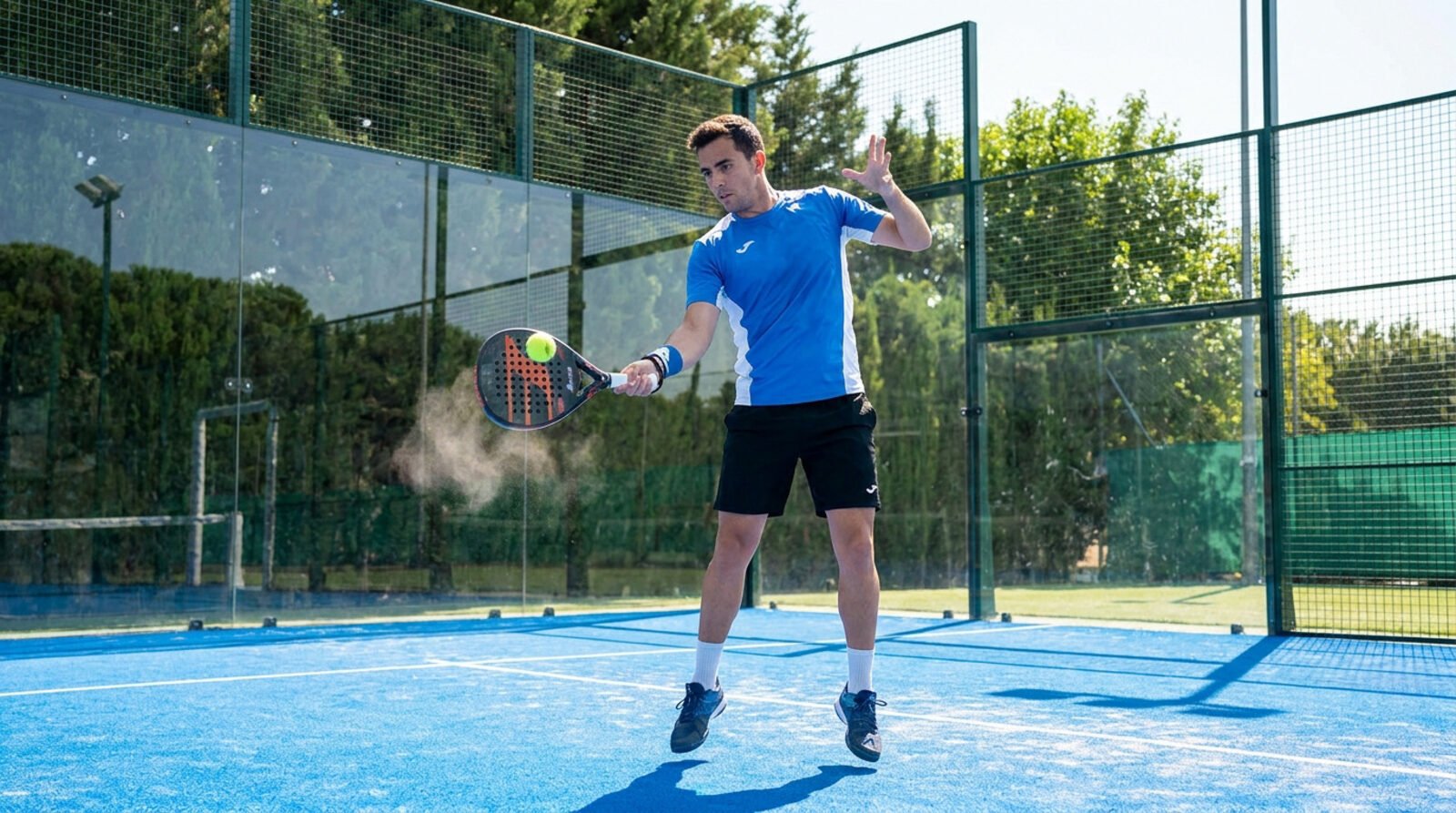
The power of the smash is decisive in modern padel, where one crisp impact can flip the outcome of an entire set. Yet raw strength alone guarantees nothing if it isn’t paired with precise technique and smart positioning on the court.
Many players miss easy balls because of poor timing, or end up with shoulder pain because of faulty biomechanics. In this guide, we break down the best tips and drills to help you improve your padel smash and turn your attacking shot into a devastating weapon.
- The different types of padel smash
- Biomechanics and technique for a clean impact
- 3 power and precision drills on court
- How to avoid mistakes and injuries on the smash
- Padel smash FAQ
The different types of padel smash
An effective padel smash requires mastering three variants: the flat smash for pure power, the top-spin smash to open up sharp-bouncing angles, and the bandeja for tactical control. The key lies in energy transfer from your legs and a high contact point, which maximize ball speed.
The flat smash to close out the point with power
The flat smash is the ultimate power shot. You play it on very high, comfortable balls near the net. The aim: a sharp, descending impact.
To pull off a “por cuatro” (sending the ball clean out over the back fence), you have to strike at the highest possible point. Target a bounce very close to the net: that’s what guarantees the ball flies over the back grille without the slightest effort.
A high-balance racket helps you put more force into the shot. Have a look at these three tips to improve your padel smash to fine-tune your attacking technique starting today.
The top-spin smash to open up angles
To generate that spin, you need a smooth upward swing. The racket “combs” the back of the ball with speed. The result: the ball jumps massively high after hitting the back glass.
The parabolic trajectory that comes off it is punishment for your opponents. The top-spin effect makes defending almost impossible: the ball flies sideways or kicks up in totally unpredictable ways.
- Bigger safety margin over the net.
- Extremely hard to block for your opponent.
- Total control of sharp angles.
Tactical differences with the offensive bandeja
The smash carries more risk than the bandeja, which prioritizes safety. The smash aims to close the point immediately, while the bandeja keeps you at the net. It all comes down to your intent on the shot.
You have to weigh your choice based on the depth of the incoming lob. If the ball lands short, the smash is mandatory. If the lob lands deep, the bandeja stays the smarter option.
Deciding fast is vital. Success depends on your early read.
Biomechanics and technique for a clean impact
Once you understand the smash variants, you have to break down the body movements that let you execute them with surgical precision.
Reading the lob and adjusting your footwork
Moving fast is essential. Use side-shuffle steps to place yourself right under the vertical line of the ball. Never strike while backing up or losing balance on the court.
Your free arm is your guide. Point it straight at the ball to measure the exact distance: that’s what helps you balance your body weight during the rotation.
Mastering padel smash technique takes patience. Constantly adjust your stance: that’s how you improve your padel smash with the right tips and drills.
The whip effect to maximize speed
Your wrist has to act like a spring. The motion must be smooth, never rigid or forced. Snap the wrist exactly at the moment of impact: that generates incredible terminal speed without depending solely on brute force.
Energy starts from the ground. Bend your knees to load the drive. Then transfer that power through the trunk via an explosive rotation that finishes in your arm.
You can boost your smash speed through repetition. Drill this technical pattern regularly.
3 power and precision drills on court
Theory only matters when applied on court. These targeted drills will turn your power into real, measurable results on the court.
Upper-body explosiveness work
Strengthening your shoulders and back is vital for a dominant swing. The rotator cuff demands special attention to avoid injury. A solid pectoral lets you accelerate far more aggressively.
Using resistance bands builds load tolerance during the cocking phase. These accessories mimic the tension right before impact. Band work helps you gain the arm speed you need.
| Exercise | Target zone | Sets × reps | Goal |
|---|---|---|---|
| Overhead press | Shoulders | 3 × 10 | Base strength |
| Resistance-band pullover | Lats / Pecs | 3 × 12 | Acceleration |
| External rotations | Rotator cuff | 3 × 15 | Stability |
| Explosive push-ups | Upper body | 3 × 8 | Pure power |
Precision drills to fine-tune direction
Training with visual targets transforms your game. Place markers in the corners of the court. Hit the targets in a sequence to build full control.
Run sets of reps with feeds at different heights. A partner should constantly vary the ball. Alternate between flat and top-spin smashes depending on the incoming trajectory.
Mastering direction is what separates amateurs from experts. For that, I recommend these drills to improve your smash with flawless technique. Try them today!
How to avoid mistakes and injuries on the smash
Hitting hard is pointless if you end up in the trainer’s room or if you miss easy balls because of poor game reading.
Timing errors and ball reading
Fix the late hit. Many players cock the arm too late. Anticipation is the key to a clean, powerful impact.
Think about outside factors too. Heat raises ball pressure. Conversely, humidity makes balls heavy and harder to send out.
Adjust your power to the weather. Never ignore the day’s conditions.
Preventing shoulder and elbow injuries
Build prehab into your routine. Do shoulder-specific warm-ups. Post-match stretching prevents overload on the elbow tendon.
Choose your racket carefully. Favor a mid-balance model: it reduces vibrations that travel up to your main joint.
Listen to your body at all times. Persistent pain demands immediate rest.
Own the high contact point, transfer your energy from the legs up, and alternate between power and spin depending on the opponent. Apply these precision drills starting today to turn your smash into a lethal weapon. Train with intensity and take over the net in your next match!
Which grip for the padel smash?
The continental grip — the so-called hammer grip — is the one to use. Hold the racket as you would hold a hammer to drive a nail into the wall in front of you: the V formed by your thumb and index finger sits on the top-left bevel for a right-hander, the top-right bevel for a left-hander.
Why this one and not another? Because it is the only grip that lets you hit flat and with slice without changing your hand, and the smash is rarely the only shot you play in a rally. Switching grips mid-point costs you the fraction of a second you need to get under the lob.
- Too closed a grip (rotated towards a forehand grip) buries the ball into the ground. You gain power and lose all control of the bounce height — the exact opposite of what a by-three smash needs.
- Too open a grip opens the racket face, the ball floats, and you have just handed your opponents an easy net position.
- Grip pressure matters as much as grip position: loose during the preparation, firm only in the last few centimetres before impact. A hand clenched from the start blocks the wrist, and the wrist is where most of the racket-head speed comes from.
A practical check: play a few smashes and look at where the ball lands. If it dies at your opponents’ feet without ever rising, your grip is too closed. If it sits up invitingly at chest height, it is too open.
Can you smash the ball out of the court?
Yes — but only where the club allows out-of-court play, and the outcome depends on which way the ball leaves the court. This is set out in the Rules of Padel of the International Padel Federation, revision applicable from 1 January 2026, Rule 13 (point lost) and Rule 14 (correct return).
- Out over the back wall, after a correct bounce: the point is won there and then (Rule 13.1.e). Your opponents have no right of reply, however fast they run.
- Out over a side wall, or through the gate: the point is not won yet. Your opponents may leave the court and play the ball back; they only lose the point on the second bounce, or if the ball touches something that is not part of the court (Rule 13.1.e). A return hit from outside is perfectly valid (Rule 14.1.j).
- Where out-of-court play is not authorised: a ball that leaves the marked perimeter after bouncing — sideways, at the back, or through the gate — ends the point immediately (Rule 13.1.d). Many indoor clubs are in this situation, so check before you build your tactics around it.
What this changes in practice: the classic por tres smash — hitting down hard enough for the ball to bounce over the fence — is a winner over the back wall, and only a strong advantage down the side. Aiming for the back is worth the extra risk.
Smashing a ball that has come off the back wall
Most lobs you attack will have bounced and rebounded off the glass before you reach them. That rebound changes two things, and both are footwork problems rather than technique problems.
- The ball comes towards you, not away. You have to move back past the ball, let it come off the glass, and strike it on the way down as it travels towards the net. Players who stay planted end up hitting with the ball behind their head, which is where shoulders get hurt.
- The bounce is lower and flatter after the wall. The contact point drops. That is exactly when a closed grip sends the ball into the ground; keep the face neutral and accept a slightly less aggressive smash rather than force it.
The reference drill: have a partner feed deep lobs to the glass, and play ten in a row without trying to win the point — the only objective is to arrive with the ball in front of you. Speed comes afterwards, and it comes on its own once the position is right.
Which racket helps your smash?
A racket will not fix your technique, but shape and balance decide how much free power you get on the overhead. Here are our three picks and who each one suits.
🏆 Our verdict in 30 seconds
Bullpadel Hack 03
If you are improving fast and want to attack from day one, this is the racket that will follow you for 3 years.
See price →📊 Comparison table
| Model | Brand | Level | Rating | |
|---|---|---|---|---|
| Bullpadel Hack 03 | Bullpadel | Expert | 8.7/10 | See price → |
| Nox AT10 Genius Attack 12K Xtreme 2026 | Nox | Advanced | 8.5/10 | See price → |
| Head Speed Motion (Ari Sánchez women's edition) | Head | Advanced | 8.5/10 | See price → |
🔍 Our detailed review
Bullpadel Hack 03
PremiumVerdict: If you are improving fast and want to attack from day one, this is the racket that will follow you for 3 years.
- Brand: Bullpadel
- Level: Expert
- Shape: Diamond (power)
- Weight: 370 g
- Balance: High (power)
- Overall rating: 8.7/10
- Exceptional power
- Premium carbon build
- Design proven on the pro circuit
- Maximum durability
- High price
- Less forgiving than round models
- Better after 3-6 months of play
🎯 Who is it for? Ambitious beginners who want to invest once for 2-3 years and aim for competition quickly.
The Bullpadel Hack 03 is the weapon of attackers who want to hit hard without losing control of the rally. Diamond shape, TriCarbon faces and a MultiEVA core: this is a pala designed to finish points, in the line of its emblematic ambassador Paquito Navarro.
Where it shines
On the Hack 03, power is the star. The head-heavy balance of the diamond shape transfers maximum energy into the smash and the back-wall recovery. The rigid carbon and the medium-hard foam send back a heavy ball that is hard to counter.
- Maximum power: the diamond + carbon combination is cut out for finishing points and net play.
- GRAIN surface: the rough texture grips the ball and clearly improves spin (slices, drop shots).
- Built-in comfort: the AirReactChannel system and the stock Hesacore grip limit vibration in the arm.
- Adjustable: the Custom Weight system lets you fine-tune the balance to your own feel.
The limits to know
All that power comes at a price: the Hack 03 demands solid technique. The diamond head places the sweet spot high on the face, so every off-centre hit costs you in comfort and accuracy. This is not a forgiving pala: on badly centred balls, it lets you know.
Which player is it for?
The Hack 03 is aimed at advanced to expert players, offensive ones, who come to the net to finish and are chasing power above all. If you are starting out or your swing is not yet stabilised, go for a round, softer racket before stepping up to this level of demand — our guide to racket shapes explains exactly why the diamond is the least forgiving of the three.
Verdict: a formidable attacking pala, generous in power and spin, best suited to an arm that is already conditioned. In the competition bracket, the Hack 03 is one of the benchmarks. Not sure yet? Start with our complete padel racket buying guide.
Nox AT10 Genius Attack 12K Xtreme 2026
Verdict: A power racket in diamond shape, rated 10/10 for power, for experienced players only.
- Brand: Nox
- Level: Advanced
- Shape: Diamond (power)
- Overall rating: 8.5/10
- Maximum power (10/10 at PadelZoom)
- High control for a diamond shape (9/10)
- 12K carbon faces and HR3 core
- Agustín Tapia's model, 2026 season
- Demands an already solid striking technique
- Ball output is its lowest rating (7.5/10)
- Weight given as a range (360-375 g), no fixed figure
- High price (€219.95)
🎯 Who is it for? Experienced to expert players who finish their points at the net and already have a precise strike.
The AT10 Genius Attack sold by our merchant is the 12K Alum Xtreme 2026 version by Agustín Tapia. The manufacturer classes it as advanced level, power play and diamond shape: the weight sits in the head, which delivers punch but demands a stroke that is already precise.
Specifications recorded from the merchant’s product page on 28 August 2026: carbon frame, HR3 core, 12K carbon faces, unisex model, 2026 season. The weight is given as a range, 360 to 375 g — so we do not publish a single figure. Price €219.95, one variant available.
The ratings come from the PadelZoom page for this exact version: 8.5/10 overall, with 10/10 for power and 9/10 for control, but 7.5/10 for ball output — the racket gives back what you put into it, it will not help you dig the ball out.
Who is it for? The experienced to expert player who finishes points at the net. If you are still building your technique, a diamond shape tires the arm and forgives little: look towards a round or teardrop shape instead. To understand what the shape changes, read our guide to padel racket shapes, and our racket buying guide covers weight, balance and core.
Head Speed Motion (Ari Sánchez women's edition)
Verdict: An advanced-level racket, easy to handle and precise, in its Ari Sánchez women's edition.
- Brand: Head
- Level: Advanced
- Shape: Teardrop (versatility)
- Weight: 360 g
- Balance: Medium-high
- Overall rating: 8.5/10
- Very easy to handle (9/10 at PadelZoom)
- Excellent ball output (9/10)
- Solid control (8.5/10)
- Contained price for an advanced-level racket
- Power falls behind (7.5/10)
- Fibreglass faces, less rigid than carbon
- Women's edition: one colourway, one variant only
🎯 Who is it for? Experienced players looking for a handleable, precise racket rather than a hitter's tool.
The Head Speed Motion sold by our merchant is the Ari Sánchez 2023 edition, and the manufacturer classes it as advanced level — not a beginner’s racket. Its teardrop shape lifts the balance slightly towards the head: the strike is cleaner than with a round shape, but it calls for a technique that is already in place.
Specifications recorded from the merchant’s product page on 28 August 2026: graphene frame, Power Foam core, fibreglass faces, stated weight around 360 g, all-round playing style, women’s model. Price €119.95, one variant available.
Which version you actually get: the only Head Speed Motion our merchant stocks is the 2023 Ari Sánchez women’s edition, at €119.95 (checked 27 August 2026). The Amazon listing is a Head Speed series page covering several models — make sure you are on the Motion before you order.
The ratings come from the PadelZoom page for the 2023 model, the one actually on sale: 8.5/10 overall, with 9/10 for handling and ball output, 8.5 for control and sweet spot, and 7.5 for power. That is the profile of a racket built for hand speed and precision, not for heavy hitting.
Who is it for? The experienced player who values placement and handling over raw power. If you want to finish your points at the net, a diamond shape will suit you better. To understand what the shape changes, read our guide to padel racket shapes, and see our complete racket buying guide to place it against the rest of the market.
Is there a Head Speed Motion 2026? No — not in our merchant’s catalogue. We checked the full merchant feed on 9 September 2026: it lists 14 Head rackets carrying the 2026 season tag, and none of them is called Speed Motion. The only Speed Motion on sale remains the 2023 Ari Sánchez edition described above, at €119.95. One caveat worth stating plainly: a model missing from a merchant’s feed is not proof that the manufacturer has discontinued it. What we can confirm is what we measured — this retailer’s 2026 Head line-up contains no Speed Motion.
The closest 2026 Head rackets. Specifications below are taken from the merchant’s own product sheets, recorded on 9 September 2026. Prices move fast on this catalogue, so treat them as a snapshot rather than a promise.
- Head Radical Motion 2026 — advanced, control, teardrop, 345–370 g, €139.95.
- Head Radical Team 2026 — intermediate, control, teardrop, 345–370 g, €129.95.
- Head Coello Vibe 2026 — intermediate, all-round, teardrop, 355 g, €99.95.
- Head Extreme Motion 2026 — advanced, power, diamond, 360 g, €216.00.
None of them is a like-for-like replacement, and it is worth being precise about why. The Speed Motion 2023 is filed by the manufacturer as all-round at advanced level. The two Radical 2026 models keep the teardrop shape but are filed as control rackets; the Coello Vibe 2026 keeps the all-round label but drops to intermediate; the Extreme Motion 2026 is a diamond power racket, a different tool altogether.
In short: if the 2023 Speed Motion profile is what you are after, the 2023 Speed Motion is still the one on the shelf. If you specifically want a 2026 season racket, decide first whether you are trading towards control (Radical) or towards power (Extreme) — that choice matters more than the model year. Our complete racket buying guide walks through that trade-off.
Padel smash FAQ
How do you smash in padel?
Move under the ball with quick side-shuffle steps so it sits on your vertical line, point your free arm at the ball to gauge distance, and strike at the highest reachable point. Power comes from the ground up: bend the knees, drive an explosive trunk rotation, and finish with a wrist snap right at impact — never while backing up or off balance.
Where is the contact point on a padel smash?
As high as you can comfortably reach. A high contact point is what maximizes ball speed and lets you angle the impact downward. For a “por cuatro” (sending the ball out over the back fence), strike at the very top and target a bounce close to the net so it clears the back grille.
How do you generate more power on the padel smash?
Not with brute force. Energy starts from the legs, transfers through an explosive trunk rotation, and finishes as a whip effect in a relaxed, spring-like wrist. Off court, upper-body and rotator-cuff work — overhead press, resistance-band pullovers, external rotations — builds the load tolerance and arm speed that translate into a faster smash.
Flat smash or top-spin smash — which one should I use?
Use the flat smash on short, high, comfortable balls when you want to close the point immediately with pure power. Switch to the top-spin smash to open sharp angles and make the ball kick unpredictably off the glass. If the lob lands deep, the bandeja stays the safer choice — read the depth of the incoming ball early and decide fast.
How do I avoid shoulder and elbow pain on the smash?
Warm up the shoulder specifically, add rotator-cuff prehab, and stretch after matches to spare the elbow tendon. Favor a mid-balance racket to cut the vibrations that travel up to the joint, adjust your power to the day’s conditions, and rest immediately if pain persists.