If you come from a tennis background and you keep hearing about padel, you have probably wondered whether you should actually book a court and try it. Both sports use a racket and a ball — but stopping the comparison there would be a mistake. Almost every other rule is different, and ignoring those differences will cost you your first three sessions. This guide is written for you: a curious tennis player who wants to walk into a padel club already understanding the game.
Below you will find the 5 fundamental differences between padel and tennis, a clean comparison table, and the honest answer to the question every ex-tennis player asks eventually — should you keep playing tennis, switch to padel, or do both. Spoiler: most pros do both, and you should too.
- 1. The court: 3× smaller and fully enclosed
- 2. The racket: solid, no strings
- 3. The serve: underarm only
- 4. The walls: a brand new tactical language
- 5. Doubles only — never singles
- Quick comparison table — tennis vs padel
- Verdict: should you drop tennis for padel?
- FAQ — Padel vs tennis
1. The court: 3× smaller and fully enclosed
A padel court measures 20 m × 10 m versus 23.77 m × 10.97 m for a tennis doubles court. That is already smaller — but the real game changer is that the padel court is fully enclosed on all four sides by tempered glass and metal mesh. The ball almost never leaves the playing area.
This enclosure changes the whole rhythm of the sport. Rallies last longer, defence is always possible, and tactics start to matter as much as pure power. You will find yourself recovering balls that would be clean winners on a tennis court, and you will discover that court coverage in padel is about angles and walls, not foot speed alone.
What this means if you come from tennis
The first hour of padel as a tennis player is humbling. Your reflexes tell you the ball is gone — but it bounces back off the glass and you are caught out of position. After two or three sessions, your eyes start tracking the wall trajectories naturally and you stop overhitting.
2. The racket: solid, no strings
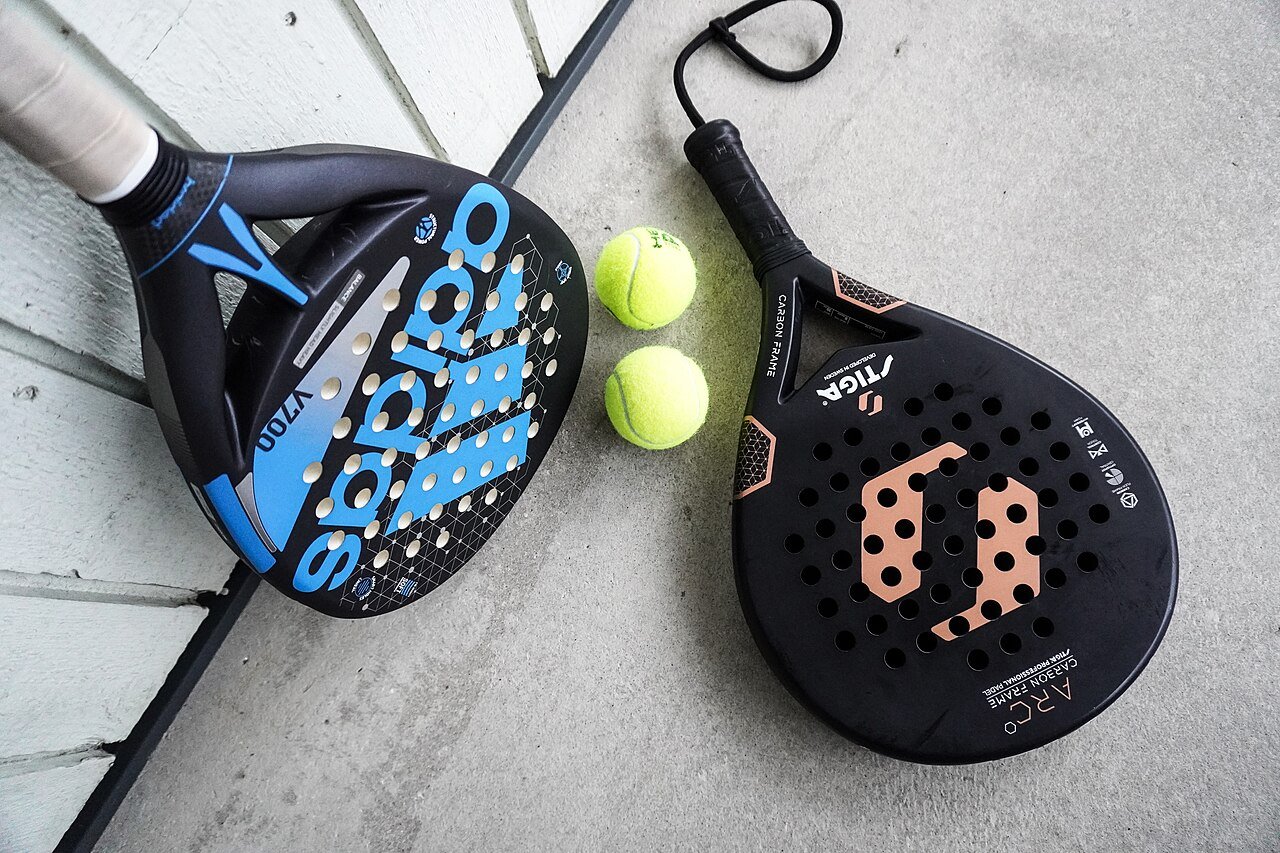
The padel racket is made of compressed foam covered with a fibre layer (carbon or fibreglass). No strings, no open string bed, no oval head. Most rackets are punched with holes for aerodynamics and weigh between 350 and 380 grams. The shape is round, teardrop or diamond depending on the playing style.
The consequence is direct: you hit with much less raw power, but you control the ball significantly better. The motion is closer to squash than to tennis, with very effective sliced and chopped shots near the net. If you keep swinging like a tennis forehand, you will spray balls into the back glass for weeks — you need to shorten your stroke and accept the trade.
For a smooth transition, start with a round-shaped racket with a balanced weight: it forgives off-centre hits and feels closest to a tennis racket in terms of stability. Our guide to choosing your first padel racket in 2026 walks you through the three frame shapes and which one fits your tennis background.
3. The serve: underarm only
In tennis, the serve is weapon number one — ace, kick, slice, the whole arsenal. In padel, it is the opposite. The serve is strictly underarm: you must bounce the ball on the ground first and then strike it below waist level, diagonally into the opposite service box.
The implications are huge for any tennis player:
- No aces are possible — every point starts on equal footing.
- The server has no real psychological advantage at the start of a game.
- The first three balls of a rally are usually tactical setups, not finishers.
- If your serve hits the side fence after the bounce, it is a fault.
- If it touches the back glass after the bounce, it is valid and playable.
The whole “big serve” weapon you spent years building in tennis becomes irrelevant. What replaces it: placement, body serves and depth. For the complete set of service rules and the broader regulatory framework, the LTA padel section publishes a clean English summary of the format used in UK and European leagues.
The body-serve trap
The most efficient underarm serve at beginner and intermediate level is the one aimed into the returner’s body, especially the backhand hip. Cramped against their own body, the returner cannot generate any angle. It is not pretty, but it works far more often than the flat power attempt you would instinctively try as an ex-tennis player.
4. The walls: a brand new tactical language
At padel, the ball is allowed to bounce on the walls before you play it (after one ground bounce, as in tennis). This single rule unlocks a tactical dimension that simply does not exist in tennis. You can lob to push the opponent off the net, wait for the ball to rebound off the glass to play it back, or hit angles that would be physically impossible on an open court.
Conversely, you must keep in your head one of the most counter-intuitive rules: your shot can only touch the opponent’s walls after bouncing on their ground. If your ball hits a wall first and then the ground, the point is yours opponents — order matters. The complete set of padel rules covers all wall situations in detail.
The por tres — padel’s most spectacular shot
If you lob your opponent and they let the ball bounce in their half, the ball can sometimes climb back over the net via their back glass and return into your court. You are then allowed to chase it down and replay it — the famous “por tres” or out-of-the-cage smash. Mastering it takes years, but watching it once will hook you on the sport.
5. Doubles only — never singles
There is no singles in padel: every match is 2 vs 2. This rule completely reshapes the nature of the game compared to tennis. Constant communication with your partner, coordinated movement up and down the court, switching sides on lobs, calling who takes the middle ball — all of this becomes part of the technical game itself.
If you enjoy the social dimension of sport, padel wins hands down over tennis. Even the best players in the world spend their warm-up debating tactics with their partner. A solo padel session simply does not exist, and that is half the appeal: you arrive, you play with three people, you leave together. The dynamic explains why couples and friend groups adopt padel so quickly.
Quick comparison table — tennis vs padel
| Criterion | Tennis | Padel |
|---|---|---|
| Court | 23.77×10.97 m, open | 20×10 m, enclosed (glass + mesh) |
| Players | 1v1 or 2v2 | 2v2 only (doubles) |
| Racket | Strung, oval | Solid (foam + fibre), round / teardrop / diamond |
| Serve | Overhead, above the head | Underarm, below the waist |
| Walls | None | Constitutive of play |
| Scoring | 15-30-40 / set | Identical |
| Learning curve | Slow (months to years) | Fast (hours to weeks) |
| Cost per player / hour | €15-25 | €6-12 |
For the broader sport-versus-sport context, both the International Tennis Federation and the International Padel Federation publish their official regulations online. The professional padel circuit is now run by Premier Padel, the unified world tour backed by the FIP since 2024.
Verdict: should you drop tennis for padel?
No — and almost no serious player does. The most common pattern is to play both sports: tennis for pure technique, sustained physical effort and the singles format; padel for instant fun, social sessions and shorter time slots. Many tennis clubs have added padel courts precisely for this reason: the two audiences overlap massively.
If you are starting from zero in 2026, padel is still the faster way to actually enjoy a rally on day one. The smash, the lob and the wall play are within reach within a handful of sessions. Want to fast-track the offensive side? Our padel smash technique guide breaks down the cleanest finishing shot at the net — the one shot where ex-tennis players have a real head start.
FAQ — Padel vs tennis
Can a tennis player switch easily to padel?
Yes. Ex-tennis players pick up the basics in three to five sessions. The trap is to keep tennis automatisms that hurt you in padel: overhead serves, full-power groundstrokes, refusing to use the back glass. Unlearning takes a few weeks but it comes naturally once you accept that padel rewards placement over power.
Is padel more tiring than tennis?
No — the opposite. Over one hour of play, a padel player covers around 2 km on average versus 4-5 km for amateur tennis. Efforts are shorter, more explosive and more tactical. That said, the wrist and shoulder work harder than you would expect because of the constant volleying at the net.
Which sport is better for kids?
For 6 to 10 year-olds, tennis remains a stronger technical foundation. For teenagers and adults, padel offers immediate accessibility and a stronger social dimension. Many national tennis federations now recommend starting with mini-tennis and adding padel from age 8 onwards.
Do padel and tennis work the same muscles?
Broadly yes, but with different dosages. Padel works the legs more (short lateral movements), the trunk (rotations) and the shoulders on volleys. Tennis works the arms more (powerful serves and groundstrokes) and the cardiovascular endurance over long rallies.
Will tennis be replaced by padel?
No. The two sports coexist and complement each other. Tennis keeps its traditional and competitive audience while padel attracts a newer, more urban crowd. The smartest clubs add padel courts on top of their tennis facilities — and players go back and forth depending on the day, the partner availability and the mood.
Ready to step on a padel court?
You now have the full picture of padel vs tennis: 3× smaller enclosed court, solid foam racket, underarm serve, wall play and mandatory doubles. The rest is identical, including the scoring you already know by heart. The fastest way to confirm the difference is to book a court this week — bring your usual tennis partner, pair up with two friends, and play your first match. Within ninety minutes you will know exactly which of the two sports you prefer, and the most likely answer is: both. Read up on the full padel rules before your first session and you will skip the most common rookie mistakes.
Article updated on 15 May 2026. Rules and figures cross-referenced with the LTA padel section, the International Tennis Federation and the International Padel Federation. Lire cet article en français.
The gear check
Babolat Counter Vertuo 2.6 2026
≈ €160 at Padel Market
Coming from tennis, the reflex is to buy for power — and to spend the first month spraying balls off the frame. A teardrop shape with a centred balance is the safer bridge: wide sweet spot, quick to handle at the net, 360 g. Babolat also builds it with the finish a tennis player expects, which makes the switch feel less like a downgrade.
Affiliate link: the price is the same for you, Padelrix earns a small commission.