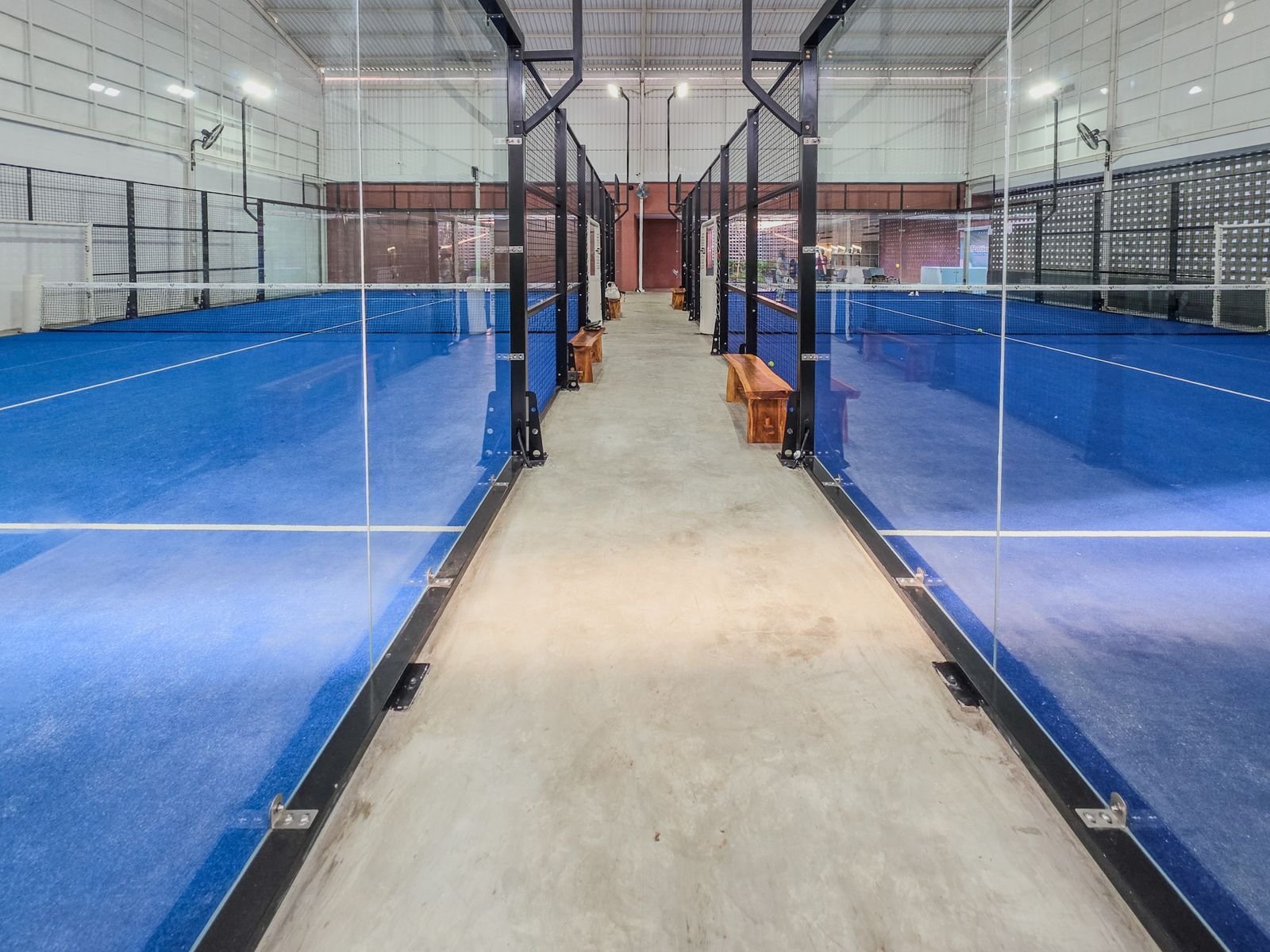
In tennis, a ball that passes you is gone. In padel, it comes back. The glass behind you turns what would be a lost point into a second chance, and learning to play off the back glass is the single most padel-specific skill there is — no other racket sport asks you to let the ball beat you on purpose.
Most beginners panic the moment the ball flies past their shoulder toward the back wall. They chase it, arrive too early, and swing with their nose against the glass. This guide breaks down how to play the ball off the back glass — reading the rebound, moving your feet, choosing the right shot — so the back of the court stops being a trap and starts being your territory.
- What playing off the glass actually means
- Reading the rebound before it happens
- Footwork and body position
- Which shot to play off the glass
- Mistakes that cost you the point
- Back glass FAQ
What playing off the glass actually means
Playing off the glass is the shot you hit after the ball has bounced once on the floor and then rebounded off the back wall or a side wall. Spanish players call it the salida de pared — literally the “exit from the wall” — and English has borrowed the idea without ever settling on one clean word for it. Whatever you call it, it is the foundation of every defensive point you will ever win.
The wall gives you a second life
A ball that flies past you is not a lost ball. It hits the glass, drops back into the court, and very often lands within comfortable racket range. Your job is not to rescue it — your job is to let the ball do its work and be waiting when it comes out. Patience beats speed here, every single time.
This is exactly where players coming from another racket sport get caught out. If you have read our breakdown of the differences between padel and tennis, you already know the walls are the structural change between the two games. A tennis player’s instinct is to sprint after anything that passes them. In padel that instinct is the fastest way to lose a point you had already saved.
Three situations, one rule
There are three glass scenarios, each with its own timing, but all of them obey the same principle: wait until the ball drops back to a comfortable hitting height.
- Back glass: the ball bounces on the floor, hits the wall behind you and returns straight toward you. The most common situation and the one to master first.
- Side glass: the ball rebounds off the side wall and comes back on a diagonal. Harder to read because the exit angle changes with every degree of incoming angle.
- Double glass: the ball chains back wall into side wall, or side wall into back wall — what Spanish players call a doble pared. It comes out slow and low, and it has to be anticipated very early.
Reading the rebound before it happens
Everything is decided before the ball touches the glass. Good defenders don’t chase the ball — they predict where it will exit the wall and are already standing there. That anticipation is a trainable skill, exactly like the swing itself, and it improves faster than your technique will.
Keep your eyes on the ball
Turn your head and rotate your shoulders enough to keep the ball inside your field of vision while it travels toward the wall. Never lose sight of it at the moment of impact: that split second tells you the height and the angle of the return. Watch the glass, not the floor.
Judge pace and spin
Pace and spin change the rebound completely, and reading them correctly is what puts you at the right distance:
- A fast ball rebounds long and comes off the glass well into the court — give yourself room.
- A slow ball dies against the wall and barely comes out — you have to step in, not back.
- A sliced ball stays low and short after the bounce, hugging the glass.
- A topspin ball kicks up violently and jumps high off the wall, which is exactly what a good attacker is looking for when they hit a topspin smash at your back glass.
Learn to adjust how far you retreat based on the spin you saw, not on habit. Two balls arriving at the same spot with different spin need two different starting positions.
Footwork and body position
Good positioning beats a good swing. On a ball played off the glass, where you stand before the rebound decides almost everything. The pattern never changes: move back early, let the ball pass, then strike while moving forward.
Move back without turning your back
Retreat with side-shuffle steps, shoulders angled toward the side wall, never with your back to the net. Turning around completely feels faster, but it costs you sight of the ball, sight of your opponents, and your balance all at once. Staying open means you can see the court and the ball in the same glance and push forward again the instant you’ve hit.
Hit the ball on the way down
Let the ball come off the glass, reach the top of its arc, and start dropping. Strike it when it falls to thigh or knee height. Hit too early and you’ll be pinned against the wall with no swing and no balance; hit too late and the ball is already dead on the floor. This window is narrow at first and becomes obvious with repetition — it is pure timing, not strength.
Recover immediately
A brilliant defensive shot is worthless if you stay glued to the back wall admiring it. The moment you finish the stroke, move back toward your base position with your partner so you don’t leave a hole in the court. Defense in padel is only ever a phase — the goal is always to get back to the net.
Which shot to play off the glass
The ball can come out of the glass low and nasty or high and friendly, and your answer has to match. Here are your main options, from the safest to the most aggressive:
| Shot | When to use it | Purpose | Difficulty |
|---|---|---|---|
| Defensive lob | Ball comes out low, you’re under pressure | Push opponents off the net, buy time | Medium |
| Topspin drive | Ball at mid-height, balanced position | Clear the net with margin, stay neutral | Medium |
| Bandeja | Ball rebounds high, you’re already forward | Hold the net, slow the point down | High |
| Víbora | High ball, ideal position | Attack with cut and sidespin | High |
| Flat counter | Ball springs out hard and high | Catch opponents flat-footed | High |
The lob is your default answer
When the ball exits low and you’re stretched, the lob is the highest-percentage shot in the game. It gives you the seconds you need to recover your position and it forces the opposing pair back off the net. A deep lob beats a spectacular counter-attack that finds the fence nine times out of ten — and if you want the full breakdown of trajectory, depth and disguise, our guide to the padel lob covers the technique in detail.
When to go on the offensive
If the ball rebounds high and sits up in front of you, defending is a wasted opportunity. Step in and play a well-placed bandeja to hold the net, or a cutting víbora if your position is genuinely ideal. Used this way, the glass stops being a survival tool and becomes a transition weapon — you absorb the attack and hand the pressure straight back.
Mistakes that cost you the point
Even experienced players throw away cheap points against the glass. Almost none of those errors are technical: they come from rushing and from bad positioning, both of which are fixable in a single session.
Hitting too early
The number one error. You play the ball before it has dropped, and you end up squeezed against the wall with no swing path and no balance. Remember what the rules allow you: as long as the ball has bounced only once on the floor, it can touch as many walls as it likes before you return it. Our complete beginner’s guide to the padel rules lays out exactly what is and isn’t legal around the walls — knowing it gives you the confidence to wait.
Running with your back to the net
Spinning around and sprinting to the back wall loses you the ball, your balance and your court awareness in one movement. Always keep one eye on the ball and one foot pointing toward the net. This particular habit shows up on almost every list of common padel beginner mistakes, and fixing it is one of the fastest ways to jump a level.
Never drilling it
Nobody improvises glass defense in a match. Spend ten focused minutes of every session having a partner feed balls into the back wall while you work on nothing but retreating and timing. No scoring, no rallies — just the rebound. Turn up early with a few fresh balls in a padel bag that carries your kit properly and you can get that block of work done before the court time even starts.
Blaming the racket
Glass defense is about timing and feet, not gear. That said, a control-oriented frame does make low balls off the wall more forgiving, which is worth knowing when you read up on round, teardrop and diamond racket shapes. Just don’t expect a new racket to fix a timing problem — it never has and it never will.
Stop surviving the back of the court and start owning it. Read the pace and the spin early, retreat with your body open, let the ball drop to thigh height, and pick the shot the rebound is offering you rather than the one you wish you had. Drill the back glass for ten minutes at your next session and the wall will quietly become the best partner you’ve got. Go tame the glass!
Read next
Back glass FAQ
Can the ball touch several walls before I hit it?
Yes. As long as the ball has bounced only once on the floor, it can hit the back glass, a side glass, or both in sequence before you return it. That’s exactly what makes double-wall rebounds playable, and it’s why panicking and rushing the ball is almost always the wrong decision.
When exactly should I hit the ball after it comes off the glass?
Let it reach the top of its rebound and hit it on the way down, at thigh or knee height. That’s the window where you have room to swing and a stable base. Too early and you’re crushed against the wall; too late and the ball has already died on the floor.
What should I play when I’m in trouble off the back glass?
A deep defensive lob. It’s the highest-percentage shot in the situation: it buys you the time to recover your base position and pushes the opposing pair back off the net, flipping the pressure without you taking any risk.
Why do I keep getting stuck against the glass?
Either you didn’t retreat far enough, or you hit too early. Start moving back the instant you read the trajectory — not when the ball passes you — and let it come fully out of the wall before you commit to the shot. Fast balls rebound long; give them more room than you think.
How do I train glass defense on my own schedule?
Have a partner or a coach feed balls into the back wall and work only on two things: retreating with side-shuffle steps and hitting on the drop. Ten minutes a session is enough if it’s deliberate. Add side-wall feeds once the back glass feels automatic, since the diagonal exit angle is the harder read.
Is glass defense harder for tennis players?
At the start, yes — and predictably so. Tennis trains you to chase a ball that passes you and to hit it before it dies, while padel asks you to let it go past, let it hit the wall, and wait. Unlearning the sprint-and-swing reflex is usually the biggest single adjustment a converting tennis player has to make.